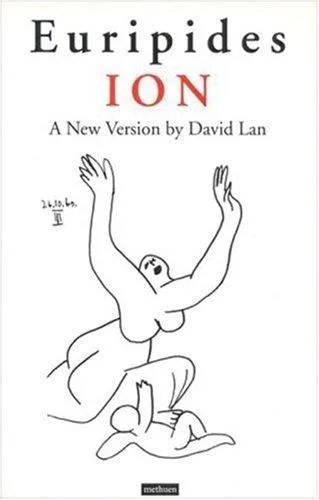
 Paperback
From the bookshelf
Download Ion EPUB & PDF
This catalogue entry identifies a specific edition. The publication details below can help you compare it with a retailer’s listing.
- Format
- Paperback
- Publisher
- Methuen Publishing, Ltd.
- Edition date
- August 25, 1994
- ISBN-13
- 9780413693303
As an Amazon Associate we earn from qualifying purchases.
From the Waterstones catalogue
About this book
he Ion is the shortest, or nearly the shortest, of all the writings which bear the name of Plato, and is not authenticated by any early external testimony. The grace and beauty of this little work supply the only, and perhaps a sufficient, proof of its genuineness. The plan is simple; the dramatic interest consists entirely in the contrast between the irony of Socrates and the transparent vanity and childlike enthusiasm of the rhapsode Ion. The theme of the Dialogue may possibly have been suggested by the passage of Xenophon's Memorabilia in which the rhapsodists are described by Euthydemus as 'very precise about the exact words of Homer, but very idiotic themselves.' (Compare Aristotle, Met.)
Ion the rhapsode has just come to Athens; he has been exhibiting in Epidaurus at the festival of Asclepius, and is intending to exhibit at the festival of the Panathenaea. Socrates admires and envies the rhapsode's art; for he is always well dressed and in good company--in the company of good poets and of Homer, who is the prince of them. In the course of conversation the admission is elicited from Ion that his skill is restricted to Homer, and that he knows nothing of inferior poets, such as Hesiod and Archilochus;--he brightens up and is wide awake when Homer is being recited, but is apt to go to sleep at the recitations of any other poet. 'And yet, surely, he who knows the superior ought to know the inferior also;--he who can judge of the good speaker is able to judge of the bad. And poetry is a whole; and he who judges of poetry by rules of art ought to be able to judge of all poetry.' This is confirmed by the analogy of sculpture, painting, flute-playing, and the other arts. The argument is at last brought home to the mind of Ion, who asks how this contradiction is to be solved.
Readers & editions
How readers find this book.
- Want to read
- 12
- Reading now
- 1
- Have read it
- 0
Subjects
Other editions & translations
-
The Ion Of Euripides
ISBN 9780548132593 Get on Amazon (opens in a new tab)
-
The Ion Of Euripides
ISBN 9781428643277 Get on Amazon (opens in a new tab)
-
Ion
ISBN 9781419126659 Get on Amazon (opens in a new tab)
-
Ion
ISBN 9780192832603 Get on Amazon (opens in a new tab)
-
Ion
ISBN 9780856682452 Get on Amazon (opens in a new tab)
-
Ion
ISBN 9780195094510 Get on Amazon (opens in a new tab)
-
Ion
ISBN 9780862920395 Get on Amazon (opens in a new tab)
-
Ion
ISBN 9783322008343 Get on Amazon (opens in a new tab)
From Wikidata
Awards & adaptations
Adaptations
Meet the authors
About the author

Digital reading tips
The format guideHow to convert between EPUB, PDF and MOBI
A different device doesn’t have to mean a different book. Choose your format below and find the steps for your next read.
Send to Kindle
Add a compatible EPUB to your Kindle library with Amazon’s Send to Kindle service.
See the stepsReflow on phones
Try Calibre for a reflowable EPUB, then check the page breaks and formatting.
See the stepsApple & Kobo
Use Calibre to prepare an EPUB for Apple Books, Kobo or another compatible reader.
See the stepsA little guidance.
A smoother read.
Calibre, Send to Kindle & online tools.
Conversion quality depends on your source file. PDF layouts may need a little tidying up.
The details behind this edition
- Full title
- Ion
- Language
- Not specified in the catalogue record
- Pages
- 80 (Open Library)
- ISBN
- 9780413693303